Viking Oven Repair
Viking Oven Still Locked Hours Later in Boston — Latch, Fuse or Sensor?
A Viking oven holds its door shut until the control reads the cavity as cool, so a lock that outlasts the evening is normal before it is a fault — unless the display has gone dark, which points at lost power or an opened thermal fuse rather than the latch.
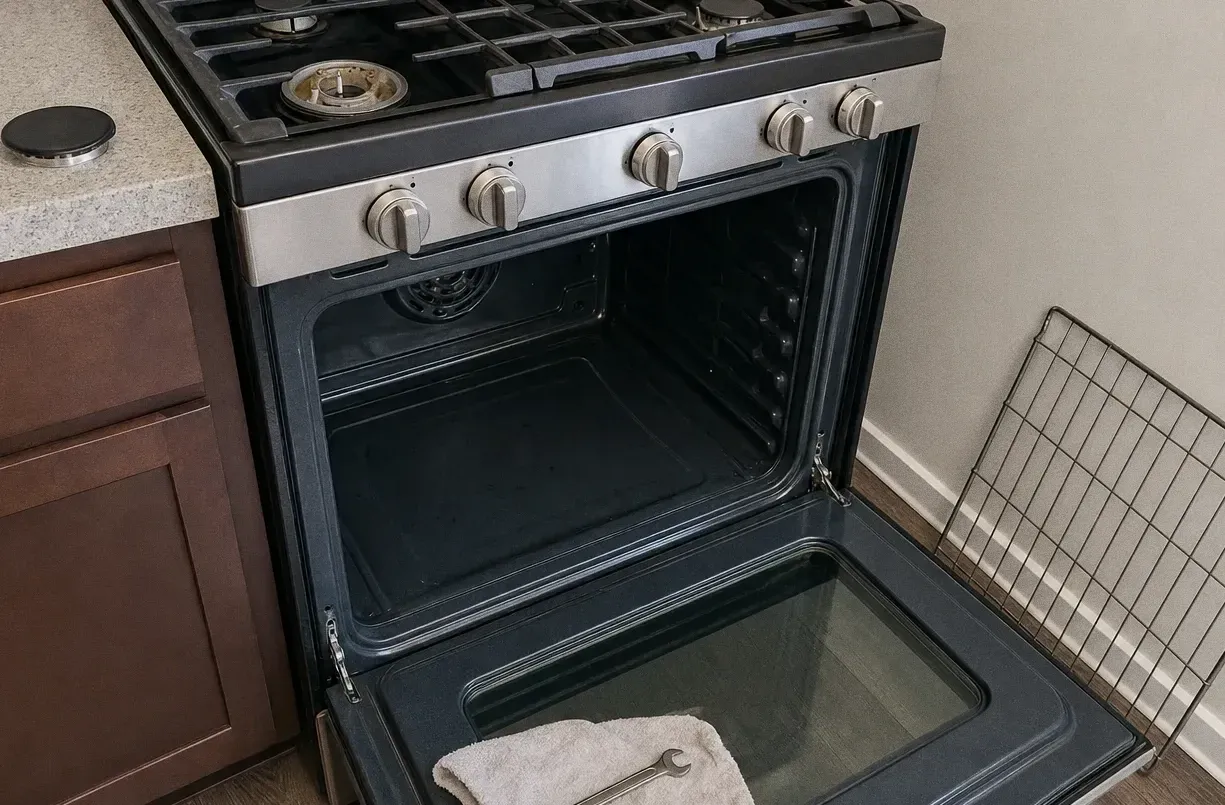
The cycle finished at some point in the afternoon. The kitchen smells faintly of scorched dust, the cavity has been cool to the touch for hours, and the door will not budge. Dinner was supposed to be in there.
Before that becomes a repair, it has to be sorted into one of two very different situations. In the first, the appliance is awake and deliberately holding the door shut. In the second, the appliance is not awake at all — the panel is dark, nothing responds, and the door is shut because nothing is left running to open it. They look identical from the front of a Boston kitchen and they are not remotely the same problem.
Everything below assumes a Viking cavity that has just come off a clean cycle. Work through it in order and you will know which of the two you have before you pick up the phone.
Before you call it a fault, wait properly
The lock is not on a timer you can watch. There is a temperature the control is waiting to see, and the door stays shut until the cavity reaches it. That moment comes long after the heating phase has ended — long enough that plenty of households decide something has broken when the appliance is only doing what it was built to do.
While you wait, collect information rather than trying things. Is the display lit? Is it showing the time, a clean indicator, or a code? Is the cooling fan still running, and does it sound normal? Anything showing on the panel is worth writing down before it disappears, because a code that clears on its own is still evidence and nobody remembers it accurately an hour later.
Waiting stops being the answer when the cavity is at room temperature — properly cold, not merely warm — and the lock is still engaged with the display awake and showing nothing unusual. At that point the control either is not seeing the temperature it should be seeing, or it has asked the latch to release and the latch has not gone.
A blank display changes the diagnosis
A dark panel moves this out of latch territory. If nothing lights, nothing beeps and no button does anything, then the question is no longer why the door is holding — it is why the appliance has no power, and the door is simply the visible consequence.
Check the breaker before anything else. A wall oven or a range in a Charlestown two-family often runs off a panel in a basement that is shared, locked, or behind somebody else’s storage, so this can take longer than it sounds. One controlled power cycle at the breaker is a legitimate test: if the panel comes back and stays back, you have learnt something. Treat it as a test rather than a repair.
If the appliance is dead with the breaker plainly on, a thermal fuse is a strong candidate. That device exists to cut power when temperature goes somewhere it should not, and a clean cycle is the hottest thing the appliance ever does, so it is exactly when one opens. A thermal fuse is a one-shot part: it opens permanently and gets replaced, never reset. And if a breaker trips again after being reset, stop resetting it. Repeatedly re-energising a circuit that keeps protecting itself is not a diagnosis, it is a way of turning one failed component into several.
The mechanism behind the door
There is a small motor behind the frame that drives a bolt across, and beside it a switch whose only job is to say where the bolt finished. Instruction and report have to agree before the control will move on. That is the entire mechanism, and it fails in two recognisable ways.
In the first, the bolt never moves — no sound of a motor working, nothing shifting behind the trim. In the second, you hear the motor run and the door still holds, which usually means the bolt travelled but the switch did not confirm it, so the control keeps the door shut because as far as it knows the door is not safe to open. Listening carefully for that difference is genuinely useful and costs nothing.
Heat contributes too. A hot cycle can leave the latch travel stiff, and spatter that carbonised during the cycle can foul the path the bolt runs in. Either way, this is the point to stop. Behind that panel is a high-current appliance that has recently been extremely hot, and getting to the latch means going into it. What is involved is described on our Viking Oven Repair page.
What a fault code is worth
A code tells you what the control observed, not which component gave up. It is the appliance reporting a reading it did not like — a sensor value out of range, a confirmation that never arrived — and several different failures produce the same report. Treating a code as a part number is the fastest way to buy the wrong thing.
What makes a code informative is its behaviour. One that appears once, clears after a power cycle and never returns points somewhere different from one that reappears the instant power comes back. The second kind is a live condition the control is still measuring.
So write it down exactly as displayed, along with what the appliance was doing when it appeared, before you reset anything. Resetting erases the most useful sentence the appliance was able to say.
What else the clean cycle may have taken with it
The cycle runs the cavity far above any cooking temperature, and that is why marginal parts pick this moment to fail. Elements, relays on the control board and door seals are the usual casualties, and they fail during the one operation that stresses everything at once.
That is also why the door sometimes opens perfectly and the trouble starts afterwards. An element that survived the heat but not the cooling, or a seal that hardened and no longer sits flat, shows up as an oven that preheats slowly, bakes unevenly, or leaks heat around the edge of the door. If the first meal after a clean cycle comes out wrong, that is related, not coincidental.
Ash and light residue in the cavity are normal and wipe out. Anything that smells electrical rather than burnt is not.
The manual alternative
An honest position on the feature: it works, and it is hard on the appliance. Running the cavity that hot finds everything marginal in it, which is useful information at a bad moment.
The practical consequence is about timing rather than avoidance. Running a clean cycle the day before a Seaport building’s freight elevator closes for the weekend, or the night before you are cooking for twelve, converts a possible fault into a certain crisis. Give it a stretch of days where an appliance out of action would be an inconvenience instead of a disaster.
Manual cleaning is a real alternative and not a lesser one. Cavity-safe cleaner, patience and a soft pad get most kitchens where they need to be without asking the appliance to endure its hardest hour.
When to stop and call
A burning-electrical smell, a breaker that goes again after it has been reset, or a door still held shut when the cavity has been cold for hours with the display awake and behaving normally: any one of those three ends the home stage.
Forcing it is not an option worth trying. Hand pressure was never something the mechanism was designed to withstand, and the two things most likely to give are the latch assembly and the door itself — turning a component replacement into a door and frame job.
A visit settles it with the measurements a kitchen cannot make. Has the thermal fuse still got continuity? Is the latch motor being told to move, and does it move? What is the sensor reporting back? And does the code on the panel describe what the appliance is really doing? We work across Charlestown, South Boston and the Seaport District, where dock hours and a booked service lift are part of the appointment — mention that when you call the number at the top of this page or use the booking link.
Asked on the same call
Should I run self-clean before a holiday?
It is the worst week you could pick. The cycle takes the cavity far above cooking temperatures, so anything already marginal — an element, a relay, a door seal — tends to fail during it or shortly afterwards. Run it when a few days without the oven would be an inconvenience rather than a disaster, and if you are in a building with booked dock hours, factor that in too.
How long should the door stay locked after a self-clean cycle?
There is no single figure, because the lock follows temperature rather than a clock. The control holds the door until it reads the cavity below its threshold, which happens well after the heating stops. Check the use and care guide for your series for the expected window. What is not normal is a door still held once the interior has been at room temperature for hours with the display working.
Will cutting power at the breaker release the latch?
No, and it is a poor habit. Removing power leaves the bolt wherever it happens to be; nothing springs open. One controlled power cycle is a fair test of whether the control re-establishes itself, but repeating it on a circuit that keeps tripping simply forces current back through something that is protecting itself. If the breaker will not stay set, leave it off and make the call.