Viking Oven Repair
Viking Oven Heating Element Replacement: Repair It or Retire It?
Replacing a burned-out bake or broil element in an electric Viking oven is usually worth it, typically $240–$730 with a firm quote after diagnosis. Retire the oven only when its age, controls and repair record all point the same way.
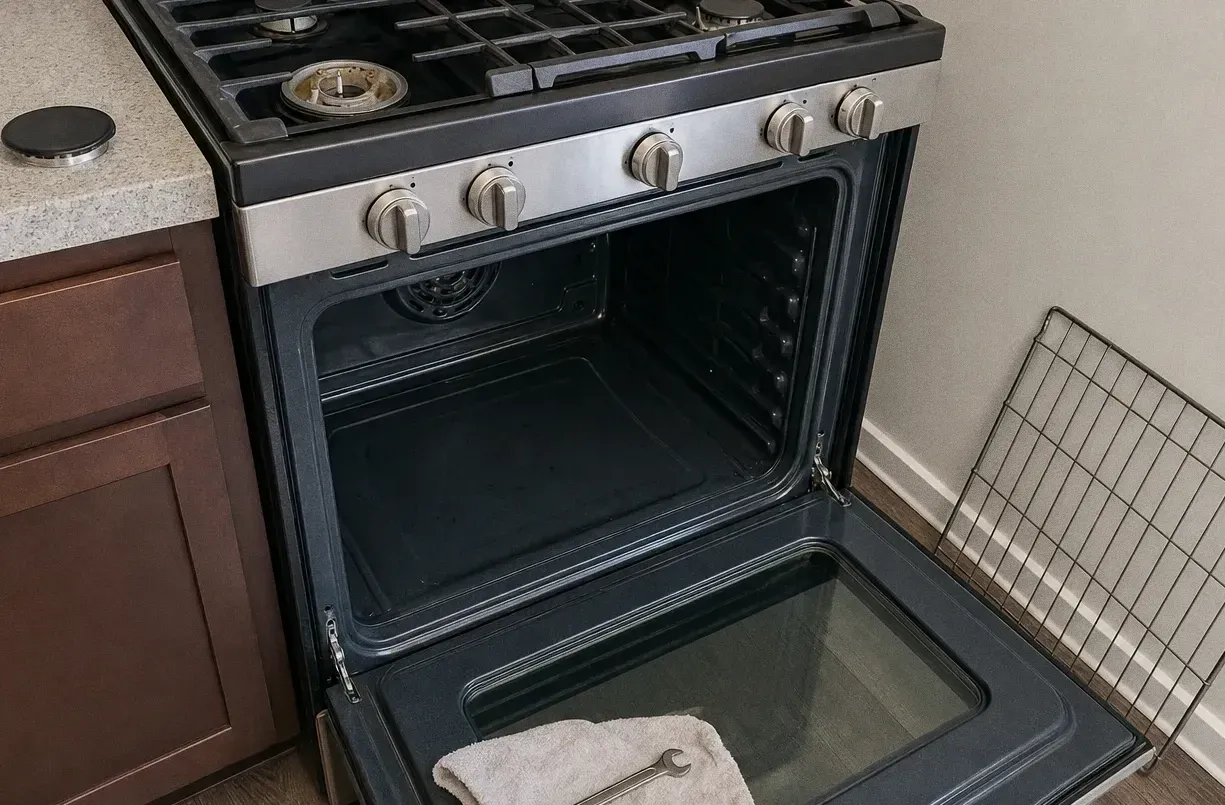
Yes: on most electric Viking ovens, replacing a burned-out bake or broil element is a repair worth making. The element is a wear part, and when the bake element is exposed the job is short. The breaker goes off, a couple of screws come out of the back wall of the cavity, two push-on terminals move across, and the new element goes in the same way. A typical bill for an oven element or thermostat repair lands in the $240–$730 range, with the firm price given after diagnosis. A flat $95 visit pays for that diagnosis, and the $95 comes off the repair if you approve the work.
The choice gets harder with a built-in. In a Seaport District condo or a South Boston triple-decker, a Viking wall oven sits in cabinetry made around its exact cutout, so retiring it means matching that opening as well as buying an oven. Four things decide it: the oven’s age, which part failed, how often parts have failed, and what replacing a built-in really involves.
Make sure the element is really what failed
A dead bake element tends to announce itself. The oven takes far longer to heat or stalls well short of the set temperature, cakes come out pale underneath while the tops brown, and with the oven cold you may see a blister, a split or a burnt spot on the metal sheath. Many owners remember the moment it went: a bright flash or a crackle from the bottom of the cavity. A failed broil element shows the reverse, with no glow at the top when you select broil.
One test settles it. With the breaker off, pull the element forward and check across its two terminals with a multimeter. No continuity means the coil inside has broken and the element is finished.
Other parts mimic these symptoms, and buying an element that was never broken wastes money. A temperature sensor, a relay on the control board or a burnt wire at the element terminals can all leave an oven cold. On Viking VESO5302T and VEDO5302T touch-control ovens, a long beep with RTD ERROR on the display means the sensor circuit is open or shorted, which is a sensor fault and not an element fault. If the element tests good but gets no power, the control is the suspect, and that work usually falls in the $370–$920 band.
Gas or electric? Check before you order anything
Viking builds both, and only one has a heating element in the oven. A 5 Series gas range warms its oven with one U-shaped bake burner rated at 30,000 BTU, and SureSpark ignition lights it along with the Gourmet-Glo infrared broiler overhead. If a gas oven will not heat, look at ignition first; our guide to Viking ignition faults walks through it, and igniter or burner work typically runs $270–$630.
Electric ovens, including the oven side of a dual-fuel range, are different. Viking pairs them with its Vari-Speed Dual Flow convection system and recommends them for baking on several racks at once. These cavities heat with a bake element near the floor and a broil element at the top, and many convection designs add a third element around the rear fan. Some bake elements sit in plain view; others hide under a floor panel, which changes how much of the oven has to come apart.
Four questions that decide repair or replace
Age comes first, and the serial number tells you. The opening six digits of a Viking serial record the build date, month first, then day, then year: 082421C10019872, for instance, came off the line on August 24, 2021. A first element failure after years of regular baking and self-cleaning is ordinary wear.
- Which part failed. An element is among the cheapest oven parts and says little about the health of the rest. A control board costs more but is still a repair, not a verdict.
- How often it has failed. A second bake element in a short time points to a cause: a loose or scorched terminal, foil on the oven floor trapping heat, or heavy use of self-clean. Fix the cause and the next element should last. An element, then a sensor, then a board within a couple of years is a different story, and it leans toward replacement.
- What replacement involves. A comparable new Viking costs many times any repair on this page for the appliance alone, before removal, cabinet adjustments or any electrical changes a new cutout needs.
One element on an oven with an otherwise clean record is almost always a repair.
Replacing it yourself, or booking a technician
An exposed bake element on a freestanding range is a fair job for a careful owner. Switch off the oven’s breaker, because turning the controls off does not cut a 240-volt circuit. Remove the racks and the screws holding the element bracket, then ease the element forward a few inches. Photograph which wire goes where, pull the terminals off without letting the wires slip back through the wall, connect the new element and refit it. Restore power and run a bake cycle to see it glow evenly.
Order the part by model and serial number, not by appearance. Aftermarket elements sold as compatible can differ in wattage, length or terminal style.
Get help when the element hides under a floor panel, when the terminals are scorched, or when the job means sliding a wall oven out of its cabinet. A built-in single or double oven is heavy and wired at the back.
Finding the model and serial number
Viking 5 Series and 7 Series electric wall ovens carry their identification plate just inside the door frame, high on the left, tucked below the controls. On a 7 Series range the rating label stays out of sight until you lower the oven door, because it sits beneath the control panel. Photograph it before you call: the model decides which element fits, and the serial gives the build date.
Warranty, cost and booking a visit
Viking’s indoor warranty gives two years of full coverage, counted from purchase or from closing on a new-construction home, whichever gives the longer term. In years three through five, electric elements move to parts-only coverage: Viking supplies the element, and the owner pays for labor and shipping. Our Viking range warranty guide covers the rest of the terms.
Viking Repair Boston works on Viking ovens in the Seaport District, East Boston, Charlestown and South Boston. To book, ring (781) 456-3468, or read what a visit covers on our Viking oven repair page. The technician tests the element, sensor and control before quoting, so the price you approve is for the part that actually failed.
Asked on the same call
Is it worth replacing the heating element in a Viking oven?
Usually, yes. An element is a wear part and one of the least expensive oven repairs, typically $240–$730 with the firm figure set after diagnosis, while a comparable new Viking unit costs many times that for the appliance alone. The exception is an oven that has needed several different major parts in a short span.
Can I replace a Viking oven element myself?
On a freestanding range with an exposed bake element, a careful owner often can: switch off the breaker, unscrew the element from the back wall, move the wires to the new part and test it. Hidden elements, scorched terminals and built-in wall ovens that must come out of their cabinet are better left to a technician.
How long does a Viking oven last?
The cavity, door and insulation of a well-kept Viking oven normally outlast its electrical parts by a wide margin, so age alone rarely settles the question. Read the build date from the serial number, where the first six digits are month, day and year, then weigh it against the repair history.
Does the Viking warranty cover a failed oven element?
It depends on how old the oven is. For two years from purchase, or from a new-construction closing if that runs longer, coverage is full. From the third year to the fifth, an electric element is covered as a part only: Viking provides the element while labor and shipping fall to the owner.
What else commonly goes wrong with Viking ovens?
Besides burned-out elements, the usual faults are ignition on gas ovens, temperature sensors, door latches on self-cleaning models and control boards. Touch-control models such as the VESO5302T report some of these on screen, for example RTD ERROR for the sensor circuit and LATCH ERROR for the door lock.